












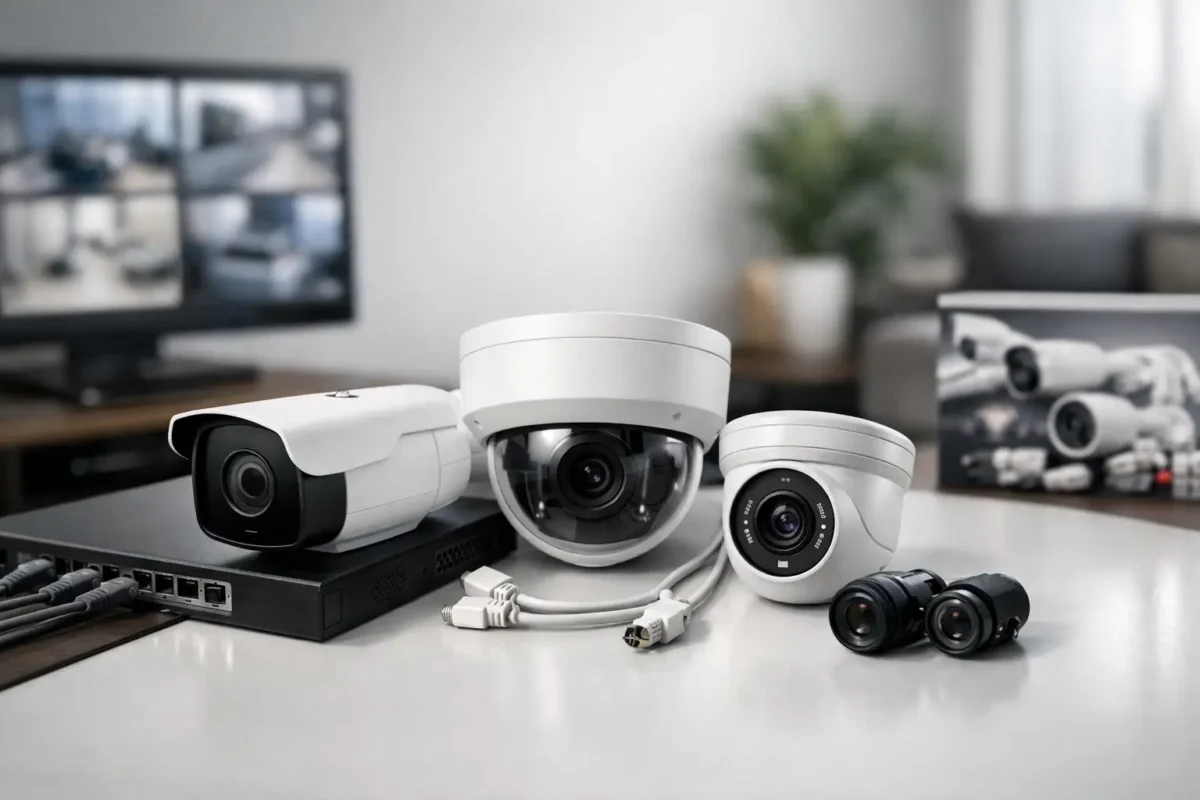
A camera kit looks simple until the wrong NVR channel count, weak nighttime coverage, or undersized storage turns a quick buy into a replacement order. That is why Hikvision IP camera kits are usually a better fit when you need matched components, cleaner deployment, and fewer compatibility questions on day one.
For IT buyers, facilities teams, MSPs, and small business owners, the real decision is not whether to buy a kit or separate parts. It is whether the kit matches the site, the retention target, and the network you already run. A low-cost bundle can be a strong value if the cameras, recorder, and power design line up with the job. If they do not, the discount disappears fast.
Why Hikvision IP camera kits make sense
The main advantage of a kit is system alignment. In a typical package, the NVR, cameras, and often the accessories are selected to work together without guesswork over ONVIF behavior, PoE budget, firmware oddities, or recording limits. That matters when the goal is fast installation and consistent operation.
For smaller offices, retail floors, warehouses, branch locations, and light industrial sites, kits also simplify purchasing. Instead of matching individual bullet cameras, domes, storage drives, injectors, and recorder specs line by line, buyers can start with a known platform and then check whether the included hardware meets site requirements. This is often the faster route for procurement teams that need branded equipment, predictable warranty coverage, and pricing that holds up against separate line-item sourcing.
There is a trade-off, though. Kits are convenient, but they are not always the most flexible choice. If you need mixed focal lengths, specialty cameras for long corridors, or unusual lighting compensation in one zone but not another, a custom build may fit better.
What to check before buying Hikvision IP camera kits
The first checkpoint is channel count. An 8-channel NVR may sound like enough for a small building, but buyers often forget future coverage. One extra entrance, a parking area, or a receiving door can use up spare channels quickly. If expansion is likely, buying a larger recorder up front is usually cheaper than replacing the recorder later.
Camera resolution is the next variable. Higher megapixel cameras can improve detail, especially for facial identification, license plate review at short distances, and wide-area coverage where digital zoom is part of the workflow. But more resolution means more bandwidth, more storage demand, and sometimes more pressure on remote viewing performance. For many offices and storefronts, the best value is not automatically the highest resolution. It is the resolution that fits the scene and the retention target.
Lens choice matters more than many kit buyers expect. Some kits include fixed-lens cameras designed for broad coverage, which is fine for entrances, lobbies, and open rooms. If you need tighter identification at distance, aisle-specific framing, or perimeter focus, a standard fixed lens may not deliver the image you expect. This is one of the clearest examples of where a kit works well for general coverage but may need upgrades for specific zones.
Night performance deserves close attention. Infrared range on a data sheet is useful, but actual low-light image quality depends on placement, reflections, ambient light, and whether the area is indoor, outdoor, or partially sheltered. A camera aimed at a bright doorway or reflective wall can perform very differently from one aimed across an open lot. If nighttime evidence quality is a priority, do not buy on megapixels alone.
NVR, PoE, and storage are where good kits win
The recorder is the center of the system, so NVR specifications should carry as much weight as the camera count. Look at incoming bandwidth, supported recording resolutions, remote access options, video compression support, and the number of drive bays. A kit can include strong cameras but still underperform if the NVR is undersized for the recording load.
Built-in PoE is one of the most practical features in many Hikvision IP camera kits. It cuts down on additional switches and power injectors and keeps deployment cleaner for smaller sites. For branch offices and basic commercial installs, this can reduce labor and shorten setup time. That said, built-in PoE on the NVR is not always the best path in larger or segmented networks.
If your environment already uses managed switching, VLAN separation, or structured surveillance traffic policies, it may be better to run cameras through your existing PoE switching infrastructure rather than home-running every camera to the recorder. That choice depends on your network design, security policy, and whether centralized switching offers better operational control.
Storage planning is where many lower-cost surveillance purchases miss the mark. Recording days depend on resolution, frame rate, scene complexity, motion settings, compression, and whether you run continuous or event-based recording. Two sites with identical camera counts can have very different storage requirements. A busy loading dock and a quiet hallway do not generate the same video load. If retention is driven by compliance, incident review, or insurance expectations, calculate for that first and price the kit second.
Matching the kit to the site
A four-camera kit can be enough for a small office with one entry, one rear door, a reception area, and a shared interior zone. For a convenience store, auto shop, clinic, or warehouse corner, that same kit may be too light almost immediately. Site shape matters as much as site size.
Indoor environments usually allow more flexibility with compact domes or turrets, where weather sealing is less of a concern and camera positioning can be optimized for faces and transaction points. Outdoor coverage raises the bar. You need to think about ingress protection, mounting height, glare, seasonal lighting shifts, and whether the image is intended for general awareness or identification.
This is also where a cheap kit can stop being a deal. If you buy a package designed for indoor general coverage and then try to use it for fence line monitoring or a dim back lot, you may end up adding replacement cameras, more storage, and different mounts. Buying the right kit once is usually less expensive than patching a marginal one.
When a kit is the best value and when it is not
For straightforward deployments, kits are hard to beat on speed and cost control. A matched Hikvision package can make sense for offices, retail, small warehouses, schools, and multi-room business spaces where the camera mix is fairly standard and the installation plan is known. Buyers get faster selection, cleaner compatibility, and usually better pricing than sourcing every component one by one.
But not every project should start with a bundle. If the site requires advanced analytics, specialized corridor views, long-range varifocal coverage, audio integration, access control tie-ins, or high-capacity archiving across many drives, a kit may be too limiting. At that point, you are building a surveillance system, not just ordering cameras.
For procurement teams and MSPs, the smartest approach is usually to treat the kit as the baseline. Check whether the included NVR, camera type, and storage profile solve 80 percent of the requirement. If yes, the package is probably worth serious consideration. If no, move to a component-based build before installation constraints show up on site.
Buying for price, not just for the spec sheet
There is no shortage of surveillance bundles in the market, but price only works in your favor when the hardware actually fits the use case. The strongest value comes from branded inventory with clear model visibility, practical warranty support, and enough product depth to move up or down based on your requirement. That is where a retailer with broad stock and deal-driven pricing can make the buying process faster, especially if you are comparing current and legacy options or balancing new versus cost-efficient replacement equipment.
At Green Code UK, that kind of hardware-first buying logic is familiar territory. Buyers looking at Hikvision IP camera kits are usually not shopping for novelty. They are trying to secure a site, control costs, and avoid ordering the wrong recorder or camera set twice.
A good surveillance purchase should leave you with fewer open questions after checkout, not more. If the kit gives you the right channels, the right image coverage, enough storage headroom, and a clean fit with your network, it is doing its job before the first camera is even mounted.
