












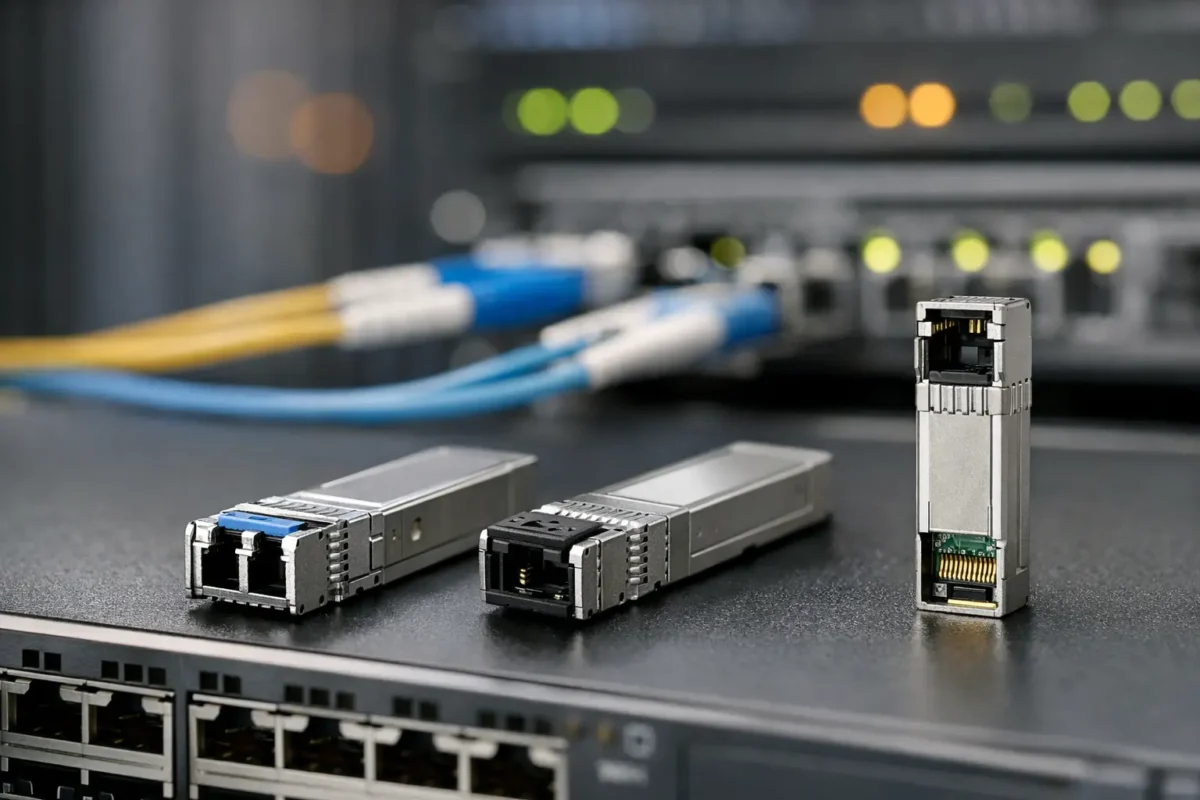
A 10Gb link that repeatedly drops, refuses to initialise, or reports an unsupported transceiver is rarely a switching mystery. More often, it is an optics mismatch: the wrong fibre type, insufficient reach, incompatible EEPROM coding, or a module selected on price alone. The best 10gb sfp modules are the ones that match the actual port, cable plant and support requirements of the network – without paying for capability the deployment will never use.
For procurement teams and network administrators, the practical choice usually comes down to four families: short-range multimode optics, long-range single-mode optics, direct-attach copper cables, and 10GBASE-T copper modules. Each has a valid place in a rack, comms room or campus link. None is automatically the right answer for every 10Gb SFP+ port.
Best 10Gb SFP Modules by Deployment Type
SFP-10G-SR: the standard choice for short fibre runs
Cisco SFP-10G-SR and compatible 10GBASE-SR SFP+ modules are the usual first choice for switch-to-switch, switch-to-server and storage links inside a building. They operate at 850nm over multimode fibre and are designed for short-reach work: up to 300 metres on OM3 and up to 400 metres on OM4, subject to the installed cabling and connector quality.
SR optics make commercial sense where an organisation already has OM3 or OM4 LC duplex fibre between cabinets or floors. They are widely available from Cisco, HPE, Dell, Juniper and third-party suppliers, and normally cost less than LR optics. For a typical 5m to 150m run between a core switch and access switch, SR is usually the sensible enterprise default.
The trade-off is clear: SR cannot be used over single-mode fibre, and older OM1 or OM2 multimode cabling reduces the supported distance significantly. Do not assume that a blue or aqua patch lead alone confirms the fibre grade. Check the cable specification before ordering optics in quantity.
SFP-10G-LR: best for building-to-building and longer links
SFP-10G-LR modules use a 1310nm laser over single-mode fibre and normally support links up to 10km. Cisco SFP-10G-LR, HPE X132 10G SFP+ LC LR, Dell-compatible LR and Juniper EX-SFP-10GE-LR equivalents are common options where links extend beyond the practical range of SR.
LR is the right fit for campus backbones, separate buildings and longer riser routes built on OS1 or OS2 single-mode fibre. It is also often chosen when a site standardises on single-mode cabling to preserve upgrade flexibility. Although the initial optic cost is higher than SR, replacing unsuitable multimode infrastructure can cost far more.
There is no benefit in selecting LR simply because it has a longer headline reach. On a very short single-mode connection, transmit power can be excessive for the receiver in some designs. Check the module’s optical budget and, where required, use an attenuator. A correctly specified LR link is reliable; an overpowered short link can be frustratingly intermittent.
SFP-10G-ER: for specialist long-distance fibre requirements
For links beyond 10km, 10GBASE-ER SFP+ optics are the usual next step. These 1550nm single-mode modules are typically rated up to 40km. They are suited to larger campus estates, remote sites and metro-style point-to-point connections where the route and installed fibre support the design.
ER modules cost considerably more and should not be treated as an upgrade from LR without a proper link-budget calculation. Fibre attenuation, splice loss, patch panels, connector cleanliness and receive sensitivity all matter at this distance. For a 20km or 30km requirement, buy the module specified for that range rather than stacking workarounds onto an LR link.
SFP+ DAC: best value inside the rack
A passive or active SFP+ direct-attach copper cable, often called DAC or twinax, is often the best purchase for very short connections. It combines both ends and the cable assembly in one part, removing the cost of two optical modules and separate patch leads. It is ideal for top-of-rack switching, server uplinks, storage arrays and adjacent racks.
Passive DACs are commonly used for the shortest lengths, often up to 3 to 5 metres depending on the platform and cable specification. Active DACs can support longer in-rack or near-rack distances, but draw more power and must be checked against the switch vendor’s compatibility guidance.
DAC is not suitable for structured cabling or long cross-room routes, and its thickness can become a cable-management issue in dense racks. Yet for a pair of 10Gb ports sitting one metre apart, it is difficult to beat for cost, low latency and simplicity.
10GBASE-T SFP+: when existing copper is non-negotiable
A 10GBASE-T SFP+ module converts an SFP+ cage to RJ45, allowing 10Gb Ethernet over suitable Cat6A copper cabling. It can be useful when a switch has spare SFP+ ports but the building is already cabled for copper, or when replacing a copper uplink without recabling.
This option needs care. 10GBASE-T SFP+ modules run hotter and consume more power than DAC or fibre optics. Some switch platforms limit supported module types, restrict the number of copper modules per switch, or require air-flow planning in dense port configurations. Reach also depends on cable quality: Cat6A is the usual target for 100m 10Gb links, while Cat6 may work only over shorter distances.
Use RJ45 SFP+ modules where copper compatibility solves a real deployment issue, not as a universal substitute for fibre. For new backbone links, fibre or DAC is usually more efficient.
Compatibility Matters More Than the Badge
The physical SFP+ form factor does not guarantee interoperability. A Cisco switch may reject an uncoded generic module, while a Dell, HPE, Juniper or Fortinet appliance may expect a different approved identifier. Some platforms offer a command to permit third-party optics; others do not, and vendor support policies may differ when non-OEM transceivers are installed.
The safest purchasing approach is to match the module to the exact switch or NIC model, not merely the manufacturer name. Confirm whether the port is 10Gb SFP+, 1Gb SFP, 25Gb SFP28, or a multi-rate interface. A 10Gb SFP+ optic will not automatically operate in a 1Gb-only SFP port, even though the modules look similar.
For critical infrastructure, check both ends of the link. One correctly coded optic is not enough if the remote device rejects the second module. Record the switch model, software release, port type, fibre mode, required distance and connector format before requesting a quote or placing an order.
How to Choose the Right 10Gb Module
Start with the cable plant. Multimode fibre generally points to SR, while single-mode fibre points to LR or ER. For short server and storage connections within or beside the same rack, DAC is usually the lower-cost choice. If the only available structured cabling is copper, assess a 10GBASE-T SFP+ module alongside its thermal and reach limits.
Next, buy for the real distance, including patching and routing, rather than the straight-line distance between two cabinets. A 90m cable run across a floor with patch panels is not a 90m optical budget in practice. Allow for connectors, splices and future alterations where the link is business-critical.
Then decide between OEM and compatible coded modules. Original Cisco, HPE, Dell and Juniper transceivers are often preferred where support compliance, standardisation or formal vendor requirements drive the decision. Professionally coded compatible modules can offer substantial savings for maintenance, lab work, expansion and cost-sensitive refresh projects, provided the supplier confirms platform compatibility and stands behind the product.
Condition also matters. New optics suit projects requiring full manufacturer packaging and predictable lifecycle status. Tested used enterprise modules can be an economical option for like-for-like replacements or legacy estates, particularly when the part number must match existing hardware. Green Code UK supplies branded enterprise hardware for both scenarios, helping buyers compare replacement options without treating every 10Gb link as a bespoke procurement exercise.
Avoid These Common Ordering Errors
The most expensive mistake is ordering by connector alone. LC duplex connectors appear on both SR and LR modules, but the fibre mode and wavelength are different. Connecting an SR optic to single-mode fibre, or an LR optic to multimode fibre, will not create a valid design just because both ends use LC connectors.
Also avoid mixing module speeds without checking port behaviour. Some switches support 1Gb and 10Gb operation only with specific optics or commands. Others have fixed-speed SFP+ ports. Check the data sheet and current firmware before assuming a 1Gb LX optic can be used as a temporary replacement in a 10Gb uplink slot.
Finally, treat cleanliness as part of the specification. Dust caps should remain in place until installation, and fibre end faces should be inspected and cleaned before connection. A premium optic cannot compensate for contaminated connectors or a damaged patch lead.
The right module is the one that makes the link uneventful: correct coding, correct fibre, realistic reach and a price that fits the job. Select those four details first, and a 10Gb upgrade becomes a straightforward hardware purchase rather than an after-hours fault ticket.

2 thoughts on “Best 10Gb SFP Modules for Enterprise Networks”
[…] Wi-Fi 6E access point can exceed the practical capacity of a 1 GbE uplink, especially where multiple clients are active on 6 GHz. Many enterprise models use 2.5 GbE ports, […]
[…] but unusable on arrival. Also verify optic type, connector format, fibre type and target speed. A 10GbE SFP+ uplink requirement is common, but it is not […]