












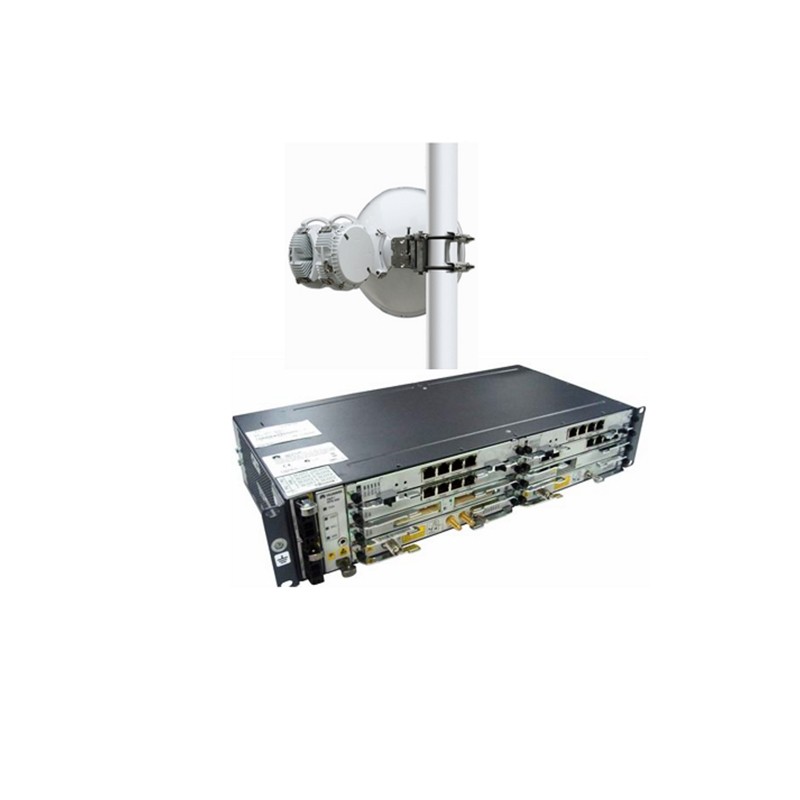
ODU(XMC-3W-7G)
| Model: | ODU(XMC-3W-7G) – Huawei RTN 950 |
| Detail: | Microwave ODU,Microwave ODU,RTN XMC,7G,-3W,X073LA,Low site,H,7093MHz,7407MHz,7275MHz,7568MHz,Without doc,WR-112,H01,154MHz/161MHz/168MHz/196MHz,Sub Band A/A/A/X,7128MHz,7268MHz |

ODU(XMC-3W-7G) is a Huawei microwave radio unit for the RTN XMC platform, operating in the 7 GHz band. The radio unit is the part that actually puts power into the air, mounted at the antenna rather than in the equipment room, and almost everything that goes wrong with a microwave order goes wrong here rather than at the indoor unit.
At 7 GHz you are in the lower licensed bands, which is where the long hops live. Links of thirty to sixty kilometres and beyond are routine because rain has comparatively little effect at this frequency. The trade-offs are congestion and antenna size: low-band dishes are large, and in many countries these channels are already heavily used.
This is a low-site unit, and it is the most important thing on this page. A microwave link transmits in one half of the band at one end and the other half at the other end, separated by the transmit-receive spacing. A working link therefore needs one high-site unit and one high-site unit. Two low-site units will never link to each other, however well aligned they are and however good the path is, because each is listening on the frequency the other is transmitting on. If you are ordering a pair, order one of each. If you are ordering a spare, order the one matching the end it is a spare for, and label it, because the two look identical on a shelf.
The transmit-receive spacing is 154 MHz. This must match the far end and the channel plan your licence was issued against. It is a property of the hardware rather than a setting, so a unit with the wrong spacing cannot be made to work by reconfiguring it. The unit is in sub-band A, and both ends of the link must be in the same sub-band.
Its tuning range is 7093 MHz to 7568 MHz, and your assigned channel has to fall inside that window. Check it against the licence rather than the band name: band edges and national channel plans do not always coincide.
The waveguide interface is WR-112, the standard rectangular waveguide size for roughly 7.05 to 10 GHz, and it has to match the antenna or branching network it bolts to. A flange mismatch is a purely mechanical problem with no electrical workaround, and it is the classic way to strand an install crew at the top of a tower.
The unit is supplied for horizontal polarisation. On a single-polarisation link both ends match. Where two links share a frequency on opposite polarisations, or one link uses cross-polarisation cancellation to double its capacity, the polarisation of each unit is part of the design and not a field choice.
The RTN 950 is a Huawei microwave platform, and its lifecycle status is genuinely unclear. Huawei’s RTN line as a whole is still an active product family, but the position of this particular model could not be established: Huawei’s lifecycle database sits behind a login and model-level end-of-sale and end-of-support dates are not published openly.
So this page will not tell you the platform is current and will not tell you it is finished, because neither can be checked from outside. If that distinction matters to your purchase, and on microwave it often does because licensed-band links tend to live for a decade, ask us to confirm it with Huawei before you commit.
Tell us the band, the channel and spacing on your licence, which end this unit is for, and the antenna it mounts to. We will confirm this is the right unit or identify the one that is. For a new link, give us both ends and we will make sure you get a matched high and low pair rather than two of the same, which is the single most common microwave ordering error.
Green Code Technologies supplies Huawei microwave equipment, including antennas, radio units, indoor shelves and the mechanical parts that join them. We are a supplier of Huawei alongside HPE, Dell, Cisco, Samsung and Netgear, and we would rather confirm a part against Huawei’s own documentation than sell you the wrong one, which on RTN 950 equipment is worth doing. Send us the band and channel on your licence, the path, and the radio and antenna models at each end and we will come back with a straight answer.
Huawei RTN 950 Specification | |
Deployment Scenario | Hub site and high-capacity access site |
Frequency | 6/7/8/10/10.5/11/13/15/18/23/26/28/32/38/42 GHz |
Channel Spacing | 3.5/ 7/14/28/40/50/56/112 MHz |
Modulation Mode | QPSK Strong, QPSK, 16QAM Strong, 16QAM, 32QAM, 64QAM, 128QAM, 256QAM, 512QAM, 512QAM Light, 1024QAM, 1024QAM Light, 2048QAM, 4096QAM |
RF Direction | 8 RF@2 U |
Air-Interface Capacity | 835-1058 Mbit/s per carrier (none-XPIC) |
Native Ethernet Maximum Throughput | ·Native Ethernet: 1058 (Mbit/s) ·L2+L3 frame header compression (IPv6): 2415 (Mbit/s) |
Switching Capacity | 10 Gbit/s |
TDM Crossing | 32 × 32 VC-4 |
Interface Type | E1, STM-1 (e/o), FE (e/o), GE (e/o), 10GE (o) |
Configuration Mode | ·N+0 (N ≤ 8) ·N × (1+0) (N ≤ 8) ·1+1 ·N+1 (N ≤ 7) ·XPIC |
Ethernet Function | ·Ethernet ll, IEEE 802.3, and IEEE 802.1q/p service format adding or deleting, and exchange VLAN tags (IEEE 802.1q/p) ·ISIS, OSPF, BGP, RSVP, LDP ·Flow control (IEEE 802.3x) ·Link aggregation groups (IEEE 802.3ad LAG and L1 LAG) ·RMON (IETF RFC 2819) |
Service Type | ·Native Ethernet services: E-Line service and E-LAN service ·PW-carried Ethernet services: E-Line service, E-AGGR service, and E-LAN (VPLS) service (VPLS standing for virtual private LAN service) ·L3VPN, L2VPN (VLL), CES, MCE (Native IP) |
Key Feature | CES E1, IEEE 1588v2, USB startup, H-QOS, PLA/EPLA/EPLA+, AES-256 encryption, Anti-theft, 1+1,N+1, XPIC, AM, TDM, PWE3/MPLS, SDB, L3VPN |
IDU Weight | ·5.4 kg (1+0) ·6.2 kg (1+1) |
IDU Dimensions | 442 mm × 220 mm × 88 mm |
Enviroment | ·Temperature: IDU -5°C to +60°C; ODU -35°C to +55°C ·Humidity: IDU 5% to 95%; ODU 5% to 100% |
Power | -38.4 V to -72 V |
Typical Power Consumption(IDU+ODU) | ·91 W (1+0) ·125 W (1+1) |
Certificate | CE, RCM, FCC, IC, ETL, MCMC |
Q & A
Related Products




Trusted IT Hardware,
Delivered Right.
Green Code Technologies is a UK-based IT hardware supplier trusted by businesses across 50+ countries — for genuine equipment, fast delivery, and expert support.
Enterprise IT Solutions Partner
Genuine, warranty-backed hardware from leading brands including Cisco, Huawei, HPE, Dell, Fortinet and more — sourced through authorised channels.
Fast UK & Global Delivery
Next-day delivery across the UK and rapid worldwide shipping. Orders placed before 2 PM are dispatched the same working day.
100% Authentic Hardware
Every product is verified for authenticity with verifiable serial numbers. We supply only genuine and certified equipment — no grey-market risk.
Expert Technical Support
Our in-house engineers provide free pre-sales and post-sales support to help you choose the right product for your infrastructure.
Competitive Pricing
We source directly from authorised supply chains to bring you the best enterprise IT hardware value without compromising on quality or warranty.
Sustainable IT Solutions
Sustainability is at our core. We offer eco-friendly certified-refurbished options alongside new hardware to reduce your organisation's carbon footprint.


Reviews
There are no reviews yet