












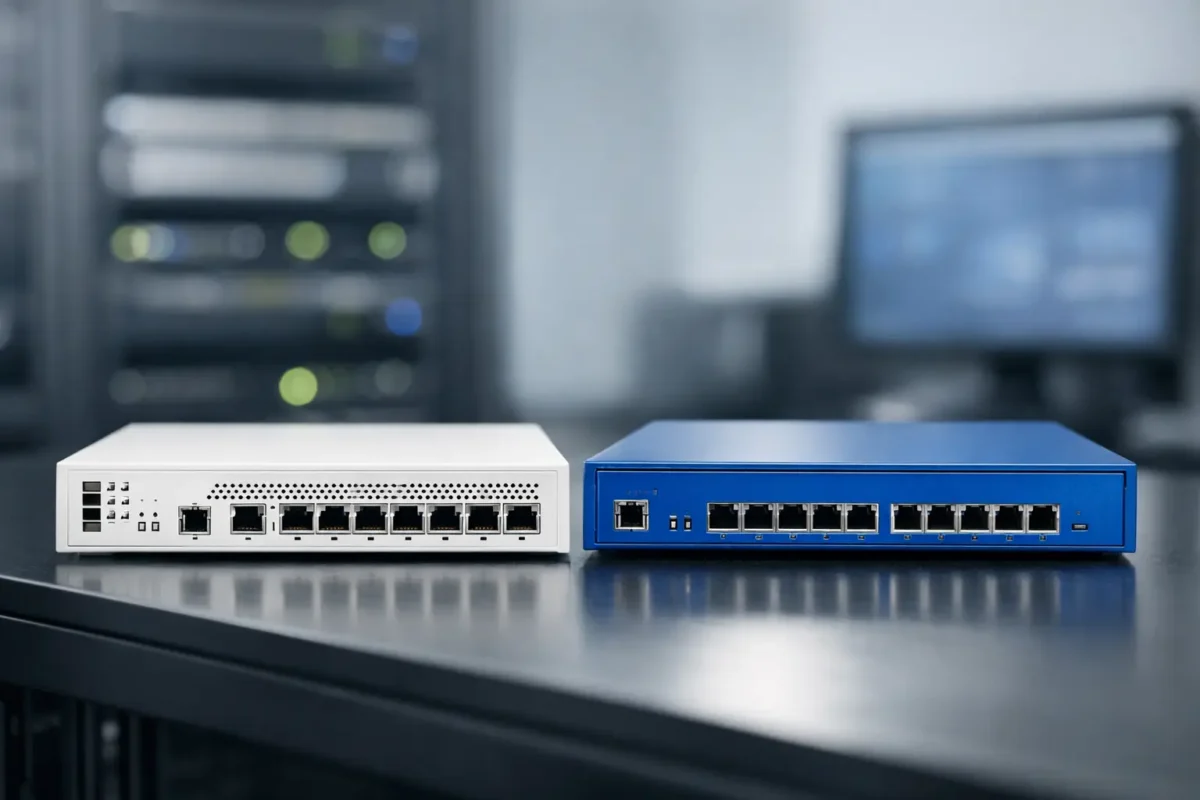
A firewall purchase can look straightforward until the quote arrives with hardware tiers, security subscriptions, support cover and renewal dates. In a Fortinet vs Sophos firewalls comparison, the best choice is rarely the appliance with the highest quoted throughput. It is the platform that matches your traffic profile, management capability, security requirements and total cost over its working life.
For IT buyers replacing an ageing UTM, securing branch offices or standardising an MSP customer estate, both manufacturers offer credible next-generation firewall options. Fortinet is often selected for performance density and broad security integration. Sophos is frequently attractive to organisations that want clear policy management and already run Sophos endpoint protection. The detail matters, especially when comparing like-for-like model numbers and licences.
Fortinet vs Sophos Firewalls at a Glance
Fortinet’s FortiGate range is built around FortiOS and, on many models, dedicated security processing units. This hardware-led approach gives FortiGate appliances a strong position where inspection performance, high connection counts and low latency are key buying criteria. It is commonly seen in busy offices, distributed retail estates, data centre edge deployments and organisations consolidating several security functions onto one platform.
Sophos Firewall, previously known through the XG range and now led by XGS appliances, centres on Sophos Firewall OS. Its biggest differentiator is the way it can exchange security information with Sophos Endpoint through Security Heartbeat. When an endpoint is identified as compromised, the firewall can apply automatic isolation or tighter access controls. For a business already committed to Sophos Intercept X or Sophos MDR, that integration can reduce response time and simplify day-to-day administration.
Neither position makes one brand automatically better. A FortiGate may be the stronger technical fit for a high-throughput multi-site WAN. A Sophos XGS appliance may be the more practical fit for a smaller IT team that wants endpoint-aware controls without adding another security management workflow.
Performance Figures Need Careful Reading
Firewall datasheets contain several throughput figures, and using the headline number alone is one of the most common procurement mistakes. Firewall throughput, IPsec VPN throughput, threat protection throughput and SSL inspection throughput represent very different workloads. A unit that appears oversized based on basic firewall throughput may become constrained once IPS, application control, web filtering, anti-malware inspection and encrypted traffic inspection are enabled.
FortiGate models often compare well on security throughput per pound, particularly where their purpose-built processors are active. This can make a material difference for organisations with fast internet circuits, substantial east-west traffic or large remote-access VPN demand. Fortinet also has a wide model spread, from compact desktop appliances through branch units to higher-capacity rackmount systems.
Sophos XGS hardware uses dedicated Xstream Flow Processors in relevant models to accelerate inspection workloads. The range has capable options for small and medium organisations, while larger appliances are available for more demanding estates. Sophos performance sizing should still be based on enabled services rather than a simple comparison of port speed or base firewall capacity.
Before ordering, establish four figures: the real peak WAN utilisation, expected growth over three years, concurrent VPN users and the proportion of encrypted traffic that must be inspected. Then compare the vendors using threat protection and SSL/TLS inspection figures, not just their maximum firewall throughput. Allow headroom. A firewall permanently operating close to its inspection limit creates poor user experience precisely when traffic and security events increase.
Ports, PoE and Physical Deployment
The right chassis is not only about processing. Check copper and fibre port counts, available SFP or SFP+ interfaces, WAN hand-offs, bypass needs and rack space. Some compact firewall models are ideal for a cabinet or branch counter, while others are designed for standard rack deployment with redundant power options.
If the firewall will support SD-WAN, dual broadband circuits and a separate guest network, make sure there are enough interfaces before relying on VLAN designs or additional switching. Buyers should also confirm the transceiver type and speed for fibre uplinks. A low appliance price can quickly lose its advantage if it requires unexpected modules, media converters or an additional switch.
Security Features and Ecosystem Fit
Both platforms provide the core next-generation firewall functions expected by most businesses: stateful inspection, IPS, web and application control, VPN, malware protection, segmentation, high availability and SD-WAN capabilities. The operational differences sit around how these services are managed and how they connect to the wider security estate.
Fortinet has a broad Security Fabric portfolio. FortiGate can work with FortiManager, FortiAnalyzer, FortiSwitch, FortiAP, FortiClient and other Fortinet products. This is useful for organisations wanting a tightly aligned network and security stack, particularly where managed switching, wireless and central logging are part of the roadmap. Fortinet is also frequently considered where security teams want granular controls, extensive inspection options and detailed operational visibility.
Sophos places more emphasis on a linked endpoint and firewall security story. Security Heartbeat can feed endpoint health information into firewall policy decisions, while Sophos Central offers cloud-based management for firewalls and other Sophos security products. This can be compelling for lean IT teams managing several sites without a dedicated network security specialist at every location.
There is a trade-off. Sophos integration is most valuable when Sophos endpoint products are already deployed or planned. If your endpoint, switching, wireless and security operations are centred on other vendors, the value of that ecosystem may be lower. Likewise, Fortinet’s wider portfolio is an advantage only if you will use it. Do not buy future platform potential at the expense of the requirements you need to meet now.
Management and Daily Administration
A firewall that is powerful but difficult to operate is an expensive risk. Both vendors offer web-based administration, central management options and reporting tools, but their administration styles differ.
FortiOS offers significant control and configuration depth. Experienced network engineers often value its policy flexibility, routing features, VPN options and diagnostic tooling. That depth can require stronger internal skills or a capable managed service provider, particularly where multi-tenant administration, advanced routing and complex segmentation policies are involved.
Sophos Firewall is commonly viewed as more approachable for smaller teams. Its policy interface, reporting and Sophos Central integration can make routine administration easier for organisations without full-time firewall specialists. However, ease of use should not be confused with a lack of planning. Rules still need clear ownership, regular review, appropriate logging and tested change control.
For an MSP, the question is often consistency. If most customers already use FortiGate, retaining Fortinet may reduce training, spare stock and support overhead. If the service desk already works in Sophos Central and protects endpoints with Sophos, adding Sophos Firewall can keep incident handling in a familiar environment. Standardisation is usually worth more than a marginal specification advantage on one site.
Licensing, Support and Total Cost
Hardware pricing is only the first line of the firewall budget. Security subscriptions determine access to threat intelligence, IPS signatures, web filtering, sandboxing, cloud management and support services. The exact bundle names and inclusions can vary by region, model and contract term, so compare written quotations rather than relying on an older datasheet or a basic appliance price.
Fortinet commonly offers FortiCare support and FortiGuard security services through packages such as UTP or Enterprise Protection. Sophos offers licence bundles that can include security services, support and management features. In both cases, identify what happens at expiry. Basic firewall functions may remain available, but protection quality, signature updates, vendor support and management features may change materially.
When comparing quotations, include the appliance, required subscriptions, support level, transceivers, rack accessories, implementation time and any HA peer. A pair of correctly sized appliances with valid subscriptions is often a better business decision than one oversized unit without a realistic resilience plan.
Used or surplus enterprise hardware can help reduce capital expenditure, especially for lab environments, non-critical sites or compatible replacement units. For production perimeter security, verify entitlement transfer, software support status, licence availability, firmware compatibility and remaining vendor lifecycle before purchase. A discounted appliance is only a saving if it can run supported software and receive the security services you require.
Which Firewall Should You Buy?
Choose Fortinet when high inspected throughput, deep network security controls, SD-WAN scale or Fortinet ecosystem integration are central to the project. It is a strong option for performance-conscious buyers, multi-site estates and teams that want extensive control over routing, segmentation and security policy.
Choose Sophos when endpoint-aware security, simpler administration and Sophos Central integration are higher priorities. It is particularly relevant for small and mid-sized organisations already using Sophos endpoint protection, or for MSPs that need a repeatable operational model for customers with limited in-house IT resources.
The deciding factor should be a short, evidence-based sizing exercise rather than brand preference. Map your circuits, users, applications, encrypted traffic, remote access requirements, interface needs and existing security tools. Then request comparable appliance and subscription configurations. The right firewall is the one your team can keep correctly licensed, updated, monitored and supported long after the initial purchase order is approved.
