












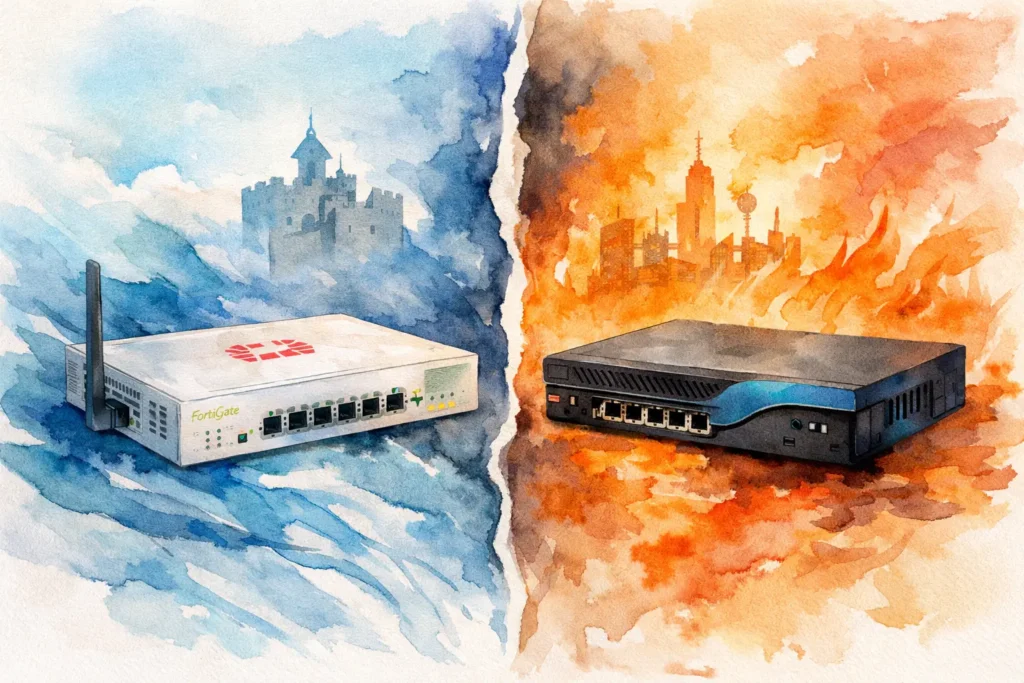
If you are weighing fortigate vs cisco firewall for a branch refresh, SD-WAN rollout, or perimeter upgrade, the right answer usually comes down to operations, licensing, and cost over time – not just brand preference. Both vendors are credible enterprise choices, but they suit different buying patterns, support models, and day-to-day admin styles.
FortiGate vs Cisco firewall at a glance
FortiGate is often the faster shortlist for buyers who want strong security features in one appliance, aggressive price-to-performance, and straightforward fit for SMB, mid-market, and distributed sites. Cisco usually appeals to organisations already invested in the Cisco estate, especially where switching, wireless, identity, and centralised policy are tied together and procurement wants one familiar vendor.
That does not make this a simple value-versus-premium decision. In plenty of real deployments, Cisco is the safer buy because the in-house team already knows the platform and can support it properly. In other cases, FortiGate delivers more usable throughput and feature density for the money, which matters when budgets are tight and stock availability affects project timing.
Where FortiGate tends to win
Fortinet has built a strong position by offering capable next-generation firewall features without pushing buyers straight into the highest spend bracket. On many models, you get solid security inspection, VPN, application control, web filtering, intrusion prevention, and SD-WAN capability in a package that feels commercially sharp.
For smaller IT teams, the attraction is often practical rather than theoretical. A FortiGate appliance can cover several functions that might otherwise mean multiple products or more complicated licensing decisions. That makes it attractive for branch offices, schools, warehouses, retail sites, and growing businesses that need performance and control but do not want overhead for overhead’s sake.
The hardware range is also broad. For businesses seeking a balance of performance, security, and scalability, the Fortinet FortiGate 100F Firewall is a popular choice for branch offices and growing organisations. Buyers can source compact desktop units for small offices, rack-mount appliances for data centre edge roles, and larger models for high-throughput environments. If your priority is stretching budget without dropping into unknown brands, FortiGate often lands in the sweet spot.
Where Cisco tends to win
Cisco’s strength is not only the firewall itself. It is the wider ecosystem around it. If your network already leans heavily on Cisco switching, routing, wireless, and identity tooling, a Cisco firewall can slot into established operational patterns with less friction.
That matters more than spec-sheet comparisons suggest. Procurement teams do not buy firewalls in isolation. They buy supportability, consistency, and lower operational risk. A platform the network team already understands can reduce deployment delays, policy errors, and training costs. In some businesses, that is worth more than a lower entry price.
Cisco also carries weight in larger enterprise environments where governance, standardisation, and vendor alignment influence every infrastructure purchase. For those teams, choosing Cisco may be as much about process and compatibility as raw feature count.
Performance and throughput: read beyond the headline number
One of the biggest traps in any fortigate vs cisco firewall comparison is trusting headline throughput without checking what is enabled. Firewall throughput, threat inspection, SSL inspection, site-to-site VPN performance, and concurrent sessions can vary sharply once real services are turned on.
FortiGate is often well regarded for performance-per-pound, especially in models aimed at SMB and mid-sized deployments. Organisations with higher throughput requirements may also consider the Fortinet FortiGate 200F Firewall, which delivers enhanced security processing and greater capacity for expanding network environments. Many buyers see attractive numbers once UTM and security features are active, which is exactly where cheaper platforms can start to struggle.
Cisco performance can still be excellent, but model selection matters. You need to map expected traffic, encrypted inspection load, remote access demand, and growth over the next three to five years. If you buy to today’s internet circuit and ignore inspection overhead, both brands can become tomorrow’s bottleneck.
This is where experienced buyers look at sizing discipline rather than marketing. Check realistic inspected throughput, not just raw firewall speed. Check interface types, uplink options, HA support, and whether the appliance still has headroom once logging, VPN, and security services are all in play.
Licensing and subscriptions can change the deal
Hardware cost is only the first line on the quote. The longer-term difference often sits in subscriptions, support entitlements, and feature packaging.
FortiGate is frequently chosen because buyers feel the commercial model is easier to justify. Depending on the deployment, the bundle can make sense quickly and the ongoing costs stay within reach for smaller organisations. If you are refreshing multiple branches at once, that price gap becomes material.
Cisco can make financial sense too, especially for organisations already under Cisco agreements or standardised support contracts. But if you are buying appliance by appliance and trying to keep branch security spend under control, the total cost can look less forgiving.
This is why procurement teams should compare three figures, not one: initial hardware spend, annual licence and support costs, and expected replacement cycle. A bargain firewall with the wrong support tier can become expensive. Equally, a premium platform that the team can manage efficiently may reduce labour cost and downtime.
Management experience and admin overhead
A firewall that looks right on paper but slows the team down every week is not a good buy. Interface design, policy handling, visibility, reporting, and central management all matter once the device is in production.
FortiGate is often praised for giving administrators a lot of control without excessive friction. For teams managing several sites, that balance can be useful. You get broad features and generally efficient administration, which helps MSPs and lean IT departments who need to move quickly.
Cisco can be a strong option where the team already knows the workflow and uses adjacent Cisco tools. In that environment, admin effort may be lower because the learning curve is gone. For a team starting fresh, though, the experience depends heavily on which Cisco platform and management approach you are adopting.
The practical question is simple: who will run it after go-live? If the answer is a two-person infrastructure team, ease of use and repeatable policy management matter a great deal. If the answer is a larger network and security function with established Cisco expertise, the equation shifts.
VPN, remote access, and branch connectivity
Remote users, branch links, and hybrid working have made VPN capability non-negotiable. Both vendors support site-to-site and remote access scenarios, but the best fit depends on how your network is structured.
FortiGate is commonly selected for mixed branch environments where value, integrated SD-WAN, and practical deployment speed are priorities. It can be a strong fit when businesses need to secure multiple smaller sites without turning every rollout into a major project.
Cisco is often attractive where remote access policies tie into broader identity and network controls, especially in Cisco-centric estates. If branch connectivity is part of a wider architecture built around existing Cisco infrastructure, the integration case can be strong.
If your estate includes many legacy circuits, variable branch sizes, and uneven local IT support, simplicity matters. Choose the platform your team can deploy and troubleshoot quickly, because remote sites rarely fail at convenient times.
Support, supply, and replacement planning
For many buyers, the best firewall is the one they can actually get, replace, and support without delay. Organisations evaluating security suppliers may also find our FortiGate Supplier Birmingham: What to Check guide useful when assessing stock availability, product expertise, and procurement support. Lead times, renewal timing, warranty options, and availability of current or previous-generation stock can all affect the buying decision.
FortiGate has often been attractive in cost-sensitive projects where buyers need to maximise spend across several sites. Cisco remains highly desirable in standardised enterprise estates, but the replacement path can be more tightly controlled by internal policy and support expectations.
This is also where secondary market and refurbished availability can help. If you need a like-for-like replacement, a temporary spare, or a lower-cost option for non-core environments, availability across model ranges becomes part of the value story. Green Code UK works with buyers who need exactly that kind of practical procurement flexibility.
So which one should you buy?
Choose FortiGate if you want strong feature density, competitive pricing, and a platform that often suits SMB, mid-market, branch-heavy, and cost-conscious deployments. It is especially compelling when you need capable security without inflating project spend.
Choose Cisco if your organisation is already operationally aligned with Cisco, your team has existing platform knowledge, or vendor standardisation matters more than chasing the lowest hardware cost. In those environments, consistency can outweigh price.
The better question is not which brand is better in absolute terms. It is which firewall fits your estate, your support model, and your budget horizon. If you compare realistic throughput, licensing, admin effort, and replacement flexibility before you buy, the right choice usually becomes obvious.
FAQ
What is the main difference between FortiGate and Cisco firewalls?
FortiGate is often chosen for its strong feature set and competitive pricing, while Cisco is frequently selected for its integration with existing Cisco infrastructure and enterprise ecosystems.
Is FortiGate cheaper than Cisco?
In many deployments, FortiGate offers a lower total cost of ownership, particularly for SMBs and branch environments, although actual costs depend on licensing, support, and deployment requirements.
Which firewall is better for small businesses?
FortiGate is commonly preferred by small and medium-sized businesses due to its balance of security, performance, and affordability.
Do both FortiGate and Cisco support SD-WAN?
Yes. Both vendors provide SD-WAN functionality, although implementation, management, and licensing models differ between platforms.
How do I choose between FortiGate and Cisco?
Consider factors such as existing infrastructure, budget, security requirements, management preferences, licensing costs, and long-term support needs before making a decision.
