





When a PowerEdge starts throwing memory warnings, slowing under virtual workloads, or hitting capacity limits long before CPU usage is maxed out, the fix is rarely guesswork. In most cases, buying the right Dell server DDR4 memory comes down to three things – exact platform compatibility, the correct module type, and a realistic view of how the server is actually used. Get those right and you avoid failed installs, wasted budget, and unnecessary downtime.
Dell server DDR4 memory: what buyers need to check first
DDR4 for Dell servers is not a generic desktop purchase. PowerEdge systems can be selective about rank, speed, voltage, module type, and population rules, and those details matter whether you are replacing a failed DIMM or expanding a production server.
The first check is the server generation and model. A Dell PowerEdge R630, R730, T430 or R740 may all use DDR4, but not always in the same way. Some support Registered DIMMs only. Others support Load Reduced DIMMs as well. Capacity ceilings, supported speeds, and CPU dependency can also vary by platform. If you are buying for a dual-socket machine, memory behaviour may change again depending on whether one or both processors are installed.
The second check is the exact memory type already fitted. If the server currently runs RDIMMs, you generally should not mix in LRDIMMs. If it uses ECC DDR4 server memory at 2133 MT/s, dropping in modules with a higher rated speed does not guarantee they will run at that speed. The platform will usually step down to the supported maximum based on CPU and motherboard rules.
The third check is workload. A lightly loaded file server and a heavily virtualised database host need different memory planning. Buying solely on the lowest price per module can look efficient at checkout, but it may force an awkward upgrade path later if all slots are consumed too early.
RDIMM, LRDIMM and ECC in Dell server DDR4 memory
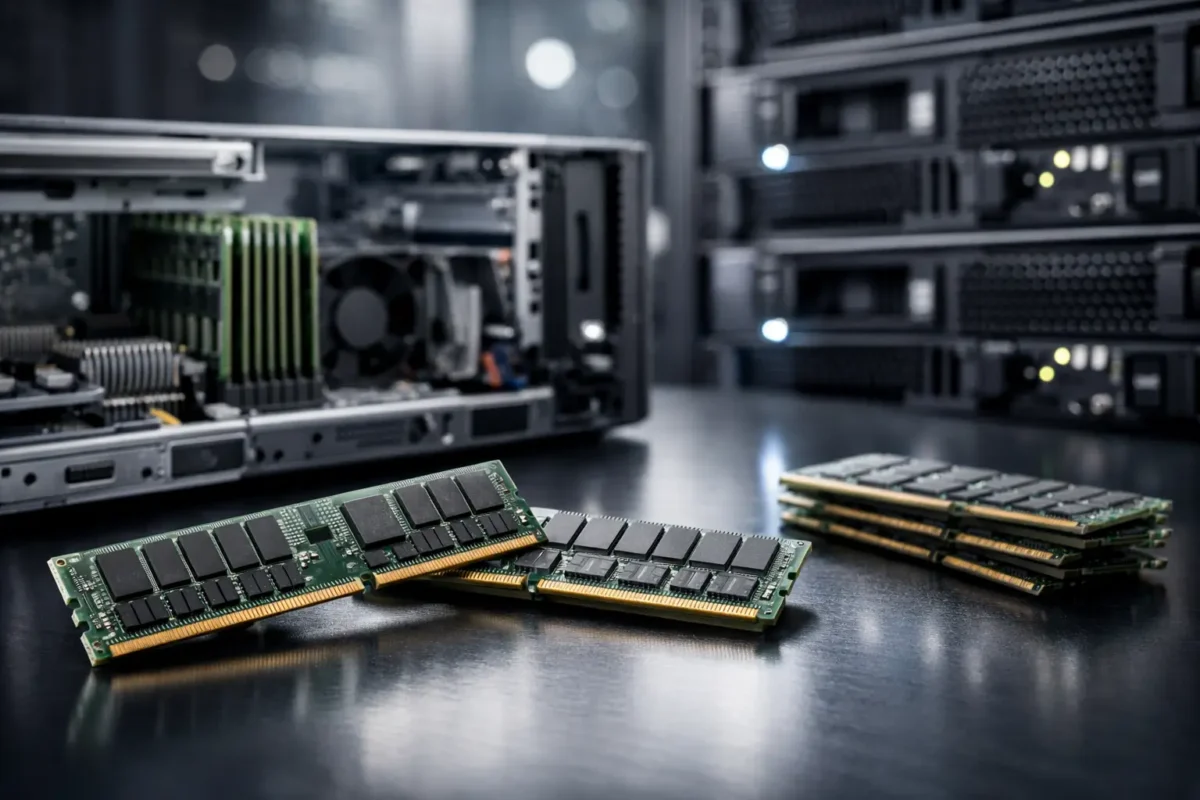
For most Dell DDR4 server platforms, buyers are choosing between ECC Registered DIMMs and ECC Load Reduced DIMMs. Both are designed for server reliability, not consumer-grade use, and both include error correction. The practical difference is usually capacity and scalability.
RDIMMs are often the right choice for general business workloads, branch infrastructure, virtualisation clusters with moderate RAM demand, and straightforward replacement jobs. They are widely available, cost-effective, and easy to source for common PowerEdge models. If you need a dependable upgrade without pushing the system to its top memory ceiling, RDIMMs usually make the most commercial sense.
LRDIMMs are more relevant where maximum memory density matters. They help reduce electrical load and allow higher capacities per server in supported systems. That matters in consolidation projects, memory-heavy virtual environments, analytics, and large in-memory applications. The trade-off is price. LRDIMMs typically cost more, and if your server will never need that density, the premium may not deliver real value.
ECC is not optional in this class of hardware. Enterprise buyers expect memory that supports data integrity and stable operation under sustained load. For Dell servers, non-ECC consumer memory is not the answer and should not be treated as a budget shortcut.
Capacity, speed and population rules
It is easy to focus on module size first – 16GB, 32GB, 64GB and so on – but speed and population rules can affect performance just as much. Dell server DDR4 memory is often offered in speeds such as 2133, 2400, 2666 or 2933, depending on the server generation and processor family. The key point is that the installed speed is usually limited by the slowest supported component in the chain.
If the CPU supports 2400 MT/s and you fit 2666 MT/s modules, the memory may simply run at 2400. That is not a fault. It is normal server behaviour. In mixed environments, the lowest common denominator often sets the pace.
Population also matters. Many PowerEdge systems are designed for balanced memory across channels and processors. Installing DIMMs unevenly can reduce performance or leave capacity inaccessible until a second CPU is installed. For example, filling six slots on a dual-socket server may be sensible if both processors are active and the channels are balanced. Filling awkward slot combinations because a cheap deal appeared on a random module size can create more problems than savings.
For procurement teams, this is where total cost matters more than unit cost. Two correctly matched 32GB modules may be a better buy than four discounted 16GB modules if the larger set preserves future expansion and follows channel rules more cleanly.
Common upgrade scenarios
Most buyers looking for Dell DDR4 server memory fall into one of four scenarios. The first is direct replacement – a failed DIMM in an existing server. In that case, matching the current specification as closely as possible is usually the fastest and lowest-risk route. Check part number, capacity, rank, speed, and module type.
The second is incremental expansion. Perhaps a PowerEdge host running Hyper-V, VMware, Veeam, or a line-of-business application has reached practical memory limits. Here, compatibility with the existing installed set becomes the priority. Not every upgrade needs a full memory refresh, but mixing should be handled carefully.
The third is a wider refresh of used or legacy infrastructure. This is common where businesses want more life from proven Dell hardware without paying current-generation server prices. DDR4 memory upgrades can be one of the most cost-effective ways to improve service headroom in these systems, especially if the CPUs and storage are still fit for purpose.
The fourth is a build or rebuild project using refurbished enterprise hardware. In this case, it often makes more sense to plan memory from scratch rather than inherit a patchwork of odd capacities and speeds. Clean, matched kits are easier to support and easier to scale.
New versus used Dell server memory
For many IT buyers, used enterprise memory is a practical purchasing category, not a compromise. In the right supply chain, used DDR4 server memory can offer substantial savings for maintenance, spares, lab environments, DR sites, and budget-conscious production upgrades. That is especially relevant for older PowerEdge generations where OEM-new stock may be limited or priced well above the real market value of the server.
That said, used memory is not a blanket answer for every deployment. If the server supports a critical production workload with strict internal procurement policies, some organisations will prefer new stock for consistency, traceability, or standardisation. Others will happily mix new and used procurement strategies depending on environment. It depends on risk tolerance, service level expectations, and budget pressure.
A practical buyer looks for tested modules, clear specification data, and warranty backing. Price matters, but verified compatibility matters more. A low-cost DIMM with vague labelling and no proper testing process is not a bargain once installation time and fault isolation are factored in.
How to avoid the usual compatibility mistakes
The most common mistake is buying on capacity alone. A 32GB DDR4 ECC module may look right on paper, but if it is the wrong type or unsupported speed grade for the platform, it is not the right product. Dell server memory should be matched to the server, not to a generic RAM category.
The next mistake is mixing RDIMM and LRDIMM in the same system. Many buyers know this rule, but it still causes avoidable returns and deployment delays. Check what is installed before ordering more.
Another regular issue is ignoring processor configuration. In some Dell servers, memory slots tied to the second CPU are inactive if that processor is not present. If a single-socket deployment is planned in a dual-socket chassis, memory placement must follow the active CPU’s slot map.
Part number discipline also helps. Enterprise buyers already work comfortably with exact model references for switches, firewalls and drives. Memory should be treated the same way. If you can source by precise Dell-compatible or OEM part number rather than broad description alone, you reduce the chance of mismatch.
Buying for value, not just for stock
The best purchase is not always the biggest module or the cheapest listing. It is the memory configuration that suits the server lifecycle, workload demand, and expansion plan without creating support headaches later. For some environments, that means low-cost replacement DDR4 RDIMMs to keep a dependable server in service. For others, it means higher-density LRDIMMs to delay a much more expensive platform refresh.
That is why serious buyers compare more than one variable at once – module type, speed, capacity, generation, condition, and availability. If stock is limited on a specific capacity, a different but still compatible layout may be the smarter commercial call. Green Code UK serves this type of buyer well because the decision is rarely about RAM in isolation. It is about keeping infrastructure online, within budget, and ready for the next expansion.
If you are buying Dell server DDR4 memory, treat it like any other enterprise component purchase – verify the platform, match the specification properly, and buy with the next upgrade in mind, not just the current fault ticket.
