












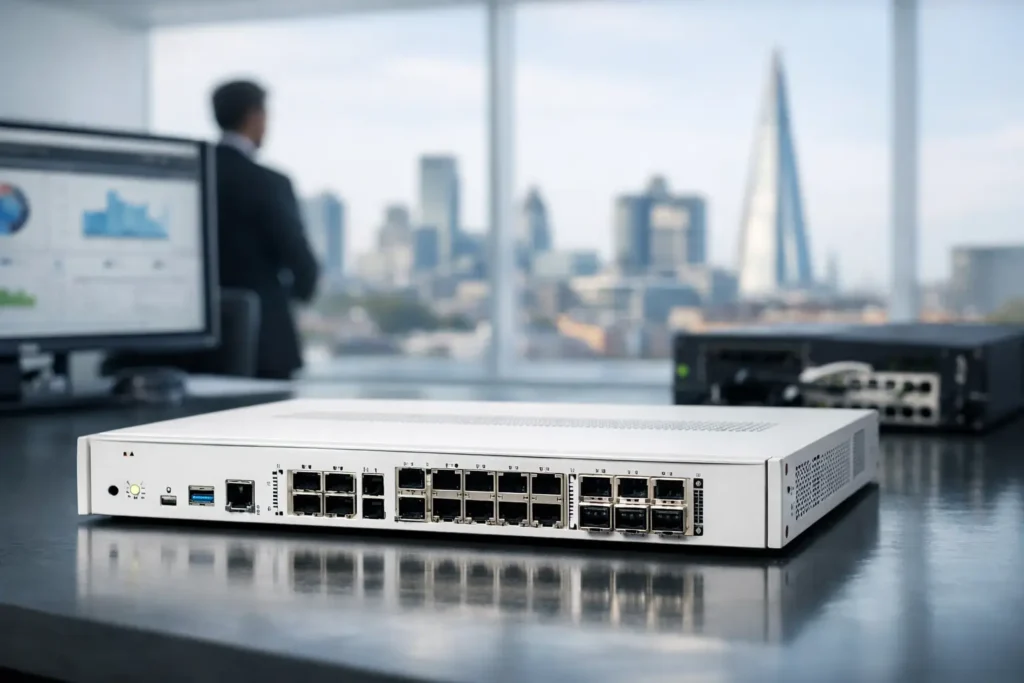
When a site-to-site VPN slows down at peak hours or east-west traffic starts bypassing older inspection policies, the issue is rarely theoretical. For many buyers searching for a FortiGate 600F enterprise firewall UK option, the real question is simple – does this appliance deliver the throughput, interfaces and security stack needed for a live business environment without forcing a move into a much larger chassis than the network actually needs?
The FortiGate 600F sits in a strong mid-to-high enterprise position. It is built for organisations that need serious firewall performance, broad interface density and Fortinet’s integrated security services, but do not want to overbuy into a platform intended for far larger campus or data centre estates. For IT teams balancing performance, cost control and deployment speed, that matters.
Why the FortiGate 600F enterprise firewall UK market stays active
In the UK market, buyers are often replacing ageing perimeter hardware, consolidating branch and head office security, or standardising across managed customer estates. The 600F attracts attention because it covers several jobs at once. It can operate as a high-capacity enterprise firewall, a secure SD-WAN edge, a VPN concentrator and a policy enforcement point for segmented internal traffic.
That versatility is useful for procurement teams trying to reduce SKU sprawl. Instead of buying one appliance for internet edge security and another for traffic control between zones, many businesses want a single Fortinet platform that can handle both roles cleanly. The 600F is often shortlisted for exactly that reason.
There is also a practical buying angle. Enterprise customers and MSPs are under pressure to keep supportable branded hardware in service while controlling capex. A model like the 600F makes sense when the requirement is not just brand familiarity but known compatibility with existing Fortinet estates, established management workflows and predictable licensing paths.
What the FortiGate 600F is designed to handle
The FortiGate 600F is not a casual upgrade from a small office appliance. It is designed for larger branch sites, distributed businesses, mid-sized enterprise cores and security-conscious environments where inspection depth and throughput both matter. Businesses requiring higher performance and greater scalability may also evaluate the FortiGate 1000F Firewall for larger enterprise deployments. If your network includes multiple WAN circuits, heavy VPN use, high user concurrency or a requirement to inspect encrypted traffic at volume, this is the sort of appliance worth evaluating.
It is especially relevant where traffic patterns have changed. Cloud applications, remote users and encrypted traffic continue to grow. As a result, older firewalls may appear adequate on paper but struggle when UTM and SSL inspection are enabled. Buyers who have faced these issues often focus on realistic security throughput instead of relying only on raw firewall performance figures
Performance is only useful if it matches the policy set
This is where many firewall purchases go wrong. A box can post strong base firewall throughput numbers, but the delivered experience depends on which services are enabled. IPS, application control, anti-malware, web filtering and SSL inspection all consume resources. The FortiGate 600F is attractive because it is intended to keep useful performance available even when organisations are running a proper security policy rather than a stripped-back ruleset.
That said, there is always an it-depends factor. If your deployment is dominated by encrypted inspection, dense east-west segmentation and very high session counts, sizing should be based on those live requirements, not headline data alone. For some estates the 600F is exactly right. For others, especially where growth is aggressive, stepping up may avoid an earlier refresh cycle.
Ports, interfaces and deployment flexibility
One of the practical strengths of the 600F is interface flexibility. Buyers looking at enterprise firewalls are rarely shopping on throughput alone. They are checking whether the appliance can slot into the existing switching and routing design without adding unnecessary transceivers, media converters or redesign work.
For that reason, port mix matters. A platform in this class is attractive when it can support diverse uplinks, segmented internal zones, DMZ requirements and high-speed handoff to switches or WAN devices. In procurement terms, that can reduce the hidden cost of deployment. The firewall price is only one part of the order. Interface compatibility, rack layout and migration effort often decide whether a model is genuinely cost-effective.
For MSPs, this also affects standardisation. If the same platform can be deployed across multiple customer scenarios without awkward workarounds, operational overhead comes down. Engineers know the platform, stockholding becomes easier and replacement planning is more predictable.
Security services and the real buying decision
A Fortinet firewall is rarely purchased for packet filtering alone. The value proposition is the wider security fabric, central management options and subscription-backed services that turn the appliance into a full inspection and control platform. That is central to any FortiGate 600F enterprise firewall UK buying decision.
You need to decide early whether the requirement is hardware-only, hardware plus core subscriptions, or a more complete service bundle. Budget-sensitive buyers sometimes focus on the appliance cost and postpone service planning. That can create a mismatch later, especially if the network design assumes IPS, application awareness, web filtering or advanced threat protection from day one.
This is also where price comparisons can get misleading. Two offers on the same model may not represent the same value if one includes stronger warranty coverage, different support terms or a more suitable licensing bundle. On paper the appliance is the same. In practice the deployment outcome can be very different.
Licensing trade-offs buyers should check
The right licence position depends on the environment. A distributed business with many branches may care more about SD-WAN control, central policy visibility and VPN features. A compliance-led organisation may place more weight on deep inspection and threat intelligence services. A business replacing a failed unit quickly may need matching support terms above all else.
That means there is no universal best package. There is only the package that fits your traffic, support expectations and security posture. Buyers who know their policy requirements before requesting quotes usually avoid the expensive mistake of under-licensing a capable appliance.
Where the 600F fits against smaller and larger FortiGate models
The 600F earns its place when smaller appliances begin to look stretched but larger chassis start to look excessive. That middle position is commercially useful. It gives businesses room for growth without jumping immediately into a higher spend category that may be hard to justify.
Against smaller models, the 600F generally offers stronger headroom for inspected traffic, more demanding VPN use and busier enterprise edge roles. Organisations with lower throughput requirements often compare the FortiGate 200F Firewall before moving to the 600F platform. Against larger models, it can be the smarter buy where the network is sizeable but not hyperscale. That balance is often the key reason it appears on shortlists for regional headquarters, larger campuses and mature SMB estates with serious security needs.
Still, the answer is not always to buy the bigger unit. If your environment is stable, user counts are moderate and SSL inspection is limited, a lower model could be enough. If traffic growth, segmentation and encrypted workloads are accelerating, the 600F may be the safer procurement choice because it delays the next refresh and gives policy teams more breathing room.
Buying considerations for UK enterprise teams
UK buyers tend to focus on four things quickly – availability, supportability, lead time and total deployed cost. Before purchasing, buyers may find our Buy FortiGate UK: What to Check First guide useful for reviewing licensing, stock availability and support considerations. A firewall may look ideal technically, but if it cannot be sourced in the required timeframe or if support alignment is unclear, it becomes a risk.
This is why product sourcing matters as much as specification. Buyers need exact model clarity, transparent hardware condition if used or refurbished stock is being considered, and a clear view of what is included. That covers rails, power supplies, support options and any bundled licences where relevant. In a busy procurement cycle, missing detail slows everything down.
For organisations managing spend carefully, it is also worth considering whether current, surplus or quality-checked used enterprise hardware offers the better route. Not every project needs factory-fresh stock. Some need a fast replacement, a lab match, a DR unit or a cost-controlled expansion. In those cases, working with a supplier that understands enterprise part matching and commercial urgency can make the purchase much more efficient. Green Code UK offers broad inventory, recognised brands and practical value for buyers who want fast, straightforward enterprise hardware sourcing.
Is the FortiGate 600F the right firewall for your network?
If your estate needs strong enterprise security performance, flexible connectivity and room to scale without moving into a larger and more expensive platform too early, the FortiGate 600F deserves serious attention. It fits best where security services will actually be used, not merely listed in a tender document.
The smartest way to assess it is not by headline throughput alone but by matching the appliance to your expected inspection load, VPN demand, interface requirements and licensing model. Get those right and the 600F can be a very efficient enterprise firewall purchase. Get them wrong and even a capable appliance becomes an expensive compromise.
The useful next step is simple – size for the policies you plan to run next year, not just the traffic you see today.
FAQ
Q1: Who should buy a FortiGate 600F?
A: It suits medium and large organisations that need high-performance security, VPN connectivity and advanced traffic inspection.
Q2: Is the FortiGate 600F suitable for SD-WAN deployments?
A: Yes. It is commonly used for SD-WAN, branch connectivity and enterprise edge security.
Q3: Should I buy a new or refurbished FortiGate 600F?
A: New units suit production environments, while refurbished units can work well for labs, DR sites and budget-conscious projects.
Q4: What affects the total cost of a FortiGate 600F?
A: Hardware condition, licensing, support contracts and subscription services all affect the final cost.
Q5: How should I size a FortiGate 600F?
A: Base sizing on inspected traffic, VPN usage, security policies and future growth rather than firewall throughput alone.
