












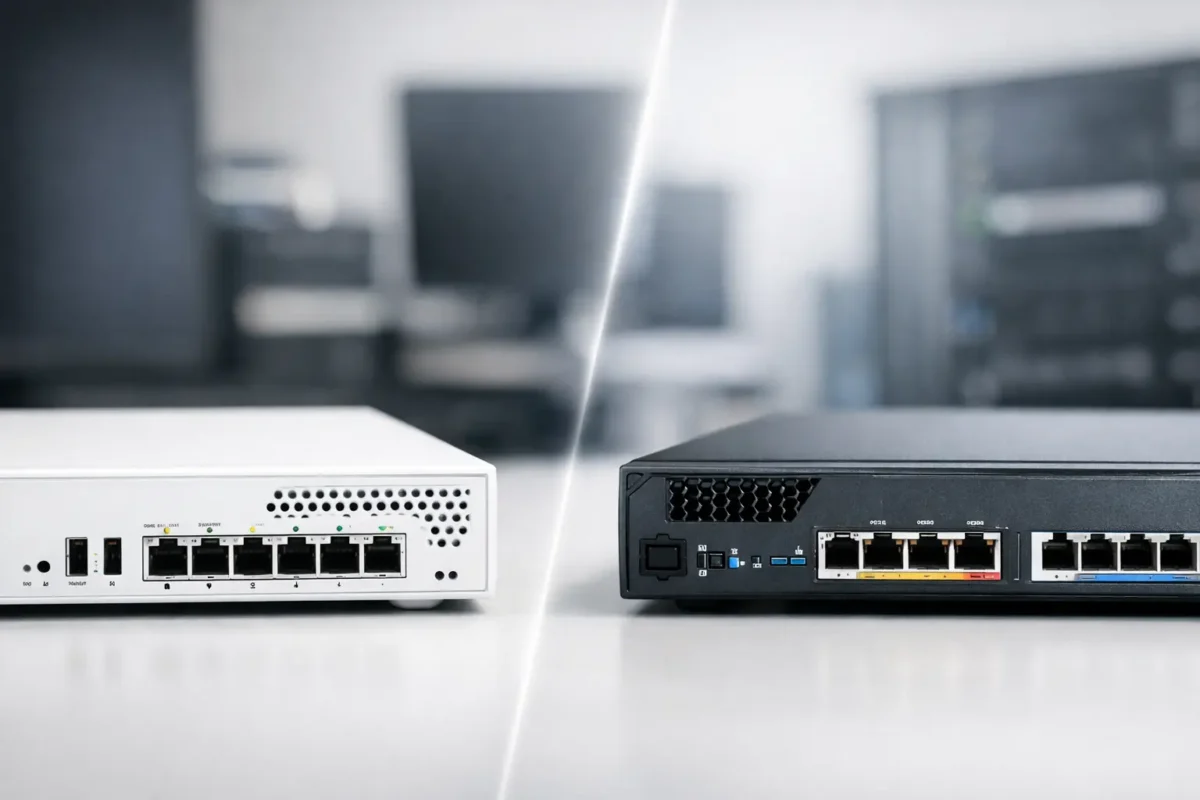
If you are comparing fortigate vs cisco asa, you are usually not browsing casually. You are trying to replace an ageing firewall, standardise across sites, cut renewal spend, or avoid buying the wrong appliance for a branch, datacentre edge, or VPN-heavy environment. That is where the differences matter – not in marketing claims, but in throughput under load, feature licensing, management overhead, and how well each platform fits the estate you already run.
For most buyers, this is not a brand loyalty question. It is a buying decision tied to risk, compatibility, and budget. Cisco ASA still appears in a huge number of production environments and remains familiar to many network teams. FortiGate, on the other hand, is often shortlisted when buyers want broader security features, stronger value per pound, and newer platform momentum.
FortiGate vs Cisco ASA at a practical level
The short version is simple. Cisco ASA is a known quantity with a long enterprise track record, particularly in environments already built around Cisco routing, switching, and VPN workflows. FortiGate is generally the more feature-dense choice for organisations that want next-generation firewall capability, integrated security services, and competitive pricing across small, mid-range, and enterprise appliances.
That does not mean FortiGate is always the automatic winner. If your team already knows ASA inside out, has stable policy sets, and mainly needs stateful firewalling plus dependable site-to-site or remote-access VPN, ASA can still make commercial and operational sense. If you need more modern application visibility, web filtering, IPS, SSL inspection, and consolidated security controls without bolting on too many extra products, FortiGate usually looks stronger.
Security features and inspection depth
The biggest gap in the fortigate vs cisco asa comparison comes from platform design and era. Traditional ASA deployments were often built around firewall and VPN first, with advanced threat functions added through separate components or adjacent Cisco products. That model can work well in larger Cisco-led estates, but it can also mean more moving parts.
FortiGate appliances are typically positioned as unified threat management or next-generation firewalls from the outset. That matters for SMBs, MSPs, and distributed businesses that want one appliance to handle firewalling, IPS, antivirus, application control, web filtering, and SSL VPN with less platform sprawl. For buyers trying to keep rack space, power draw, and licence complexity under control, that integration has real value.
Cisco ASA can still be effective when the requirement is narrower. A lot depends on whether you are comparing classic ASA units, ASA with FirePOWER services, or a migration path toward newer Cisco Secure Firewall models. Buyers sometimes say “Cisco ASA” when they really mean a mixed estate of older hardware and layered security tooling. That is why feature comparison has to be done model by model, not just badge by badge.
Performance is not just about headline throughput
Firewall datasheets are full of attractive numbers, but procurement teams know the catch. Raw firewall throughput is one thing. Real performance with IPS, SSL inspection, VPN sessions, application control, and logging enabled is another.
FortiGate often performs strongly here because Fortinet has long focused on integrated inspection with purpose-built hardware acceleration in many models. In plain buying terms, that can translate into better price-to-performance when multiple security services are turned on. That is especially relevant for branch offices, retail estates, schools, and growing mid-market environments where one box is expected to do a lot of work.
Cisco ASA performance can be solid and predictable, particularly in deployments centred on firewalling and VPN. But older ASA platforms may start to look less attractive if your requirements have shifted towards heavier encrypted traffic inspection or broader next-generation feature sets. If you are sourcing replacement hardware, always compare the expected inspected throughput, not just the base firewall number.
Management and day-to-day administration
A firewall that looks good on paper can still be expensive if it consumes too many admin hours. This is where preference and team experience matter.
Cisco ASA has a long command-line heritage, and many network engineers are comfortable with it. In established Cisco environments, that familiarity can reduce operational friction. Policy logic, object groups, NAT handling, and VPN configuration will feel familiar to teams that have supported ASA for years. If your staff already know the platform, there is value in not retraining everyone during a refresh cycle.
FortiGate is often praised for giving smaller teams a faster route to broad security policy management. The GUI is generally seen as accessible, and centralised management options can simplify multi-site administration. MSPs and lean IT teams often favour platforms that reduce the time needed to deploy, replicate, and troubleshoot policies across customer or branch estates.
That said, management preference is rarely universal. Some engineers prefer Cisco syntax and policy structure. Others find FortiGate quicker for mixed security tasks. The right question is not which interface wins an abstract beauty contest. It is which one your team can run confidently at 9am on a routine change and at 9pm during an outage.
VPN capability and remote access
Cisco ASA built much of its reputation on VPN, and that is still relevant. Site-to-site tunnels, remote access, and interoperability within Cisco-heavy networks remain strong reasons some buyers stay with ASA. If your use case is heavily VPN-led, especially in a business with older Cisco standards and operational playbooks already written around ASA, replacement with like-for-like hardware may reduce disruption.
FortiGate is also a strong VPN platform and often appeals to buyers that want remote access bundled with broader security functionality. In distributed organisations where branch security, SD-WAN style connectivity, and central policy control matter, FortiGate can present a more consolidated proposition. For SMBs and cost-conscious enterprises, that can mean fewer separate products to budget for.
The key is to review concurrent tunnel counts, authentication requirements, client support, and licensing implications. A cheap chassis stops being cheap very quickly if the remote access model does not fit your workforce.
Licensing, renewals, and total cost
This is where many decisions are actually made. Hardware cost is only the first line on the quote. Support contracts, subscriptions, feature bundles, and replacement cycles shape the real spend.
FortiGate is often attractive on total value. Buyers regularly compare it favourably on upfront pricing and on the cost of accessing multiple security services in one platform. That makes it popular with organisations that want recognised enterprise security brands but still need to keep capital and recurring spend under control.
Cisco ASA can still be commercially viable, particularly if you are extending an installed base, using features you already know, or buying replacement units for continuity rather than redesign. However, once buyers start comparing feature depth against newer requirements, older ASA-era procurement can become less efficient. In some cases, the spend required to keep pace with modern security expectations points buyers towards a broader platform refresh instead of a simple appliance swap.
For resellers and procurement teams, this is also where stock profile matters. Current-generation platforms, certified used hardware, spare units for support cover, and matching accessories can all change the economics. A strong deal on a known model with warranty can be smarter than overbuying the newest box available.
Which firewall suits which buyer?
For smaller businesses, branch offices, and buyers seeking strong value with full security services, FortiGate usually comes out ahead. It fits organisations that want one appliance to cover multiple controls, reduce vendor sprawl, and keep deployment straightforward.
For Cisco-standardised estates, legacy environments, or teams that prioritise ASA familiarity and dependable VPN operation, Cisco ASA can still be the practical choice. That is particularly true when policy migration risk is higher than the benefit of changing platforms.
For MSPs, the decision often depends on customer mix. If you support many smaller customers with varied needs and tight budgets, FortiGate can be easier to package as a broad security offering. If you support customers with long-standing Cisco estates, ASA may remain relevant for support consistency and replacement compatibility.
For enterprise procurement, the answer is usually tied to roadmap rather than brand. If the security strategy is moving towards consolidated next-generation inspection and lower per-site cost, FortiGate deserves serious attention. If the wider network and security architecture is still deeply Cisco-led, the firewall decision may be constrained by that operational reality.
The real buying question in fortigate vs cisco asa
The real question is not which badge is stronger. It is whether you are buying for continuity, capability, or cost control.
If continuity matters most, Cisco ASA may still be the lowest-friction option. If capability per appliance matters most, FortiGate often delivers more. If cost control matters most, you need to compare not only the chassis but also the support term, licence stack, and whether current or used enterprise hardware gives you the better result.
Buyers who treat firewalls as line items often overspend later. Buyers who match the platform to the network, the team, and the renewal model usually get better performance from the same budget. That is the smarter place to start, whether you are refreshing one branch appliance or sourcing a full multi-site security estate through a supplier such as Green Code UK.
