












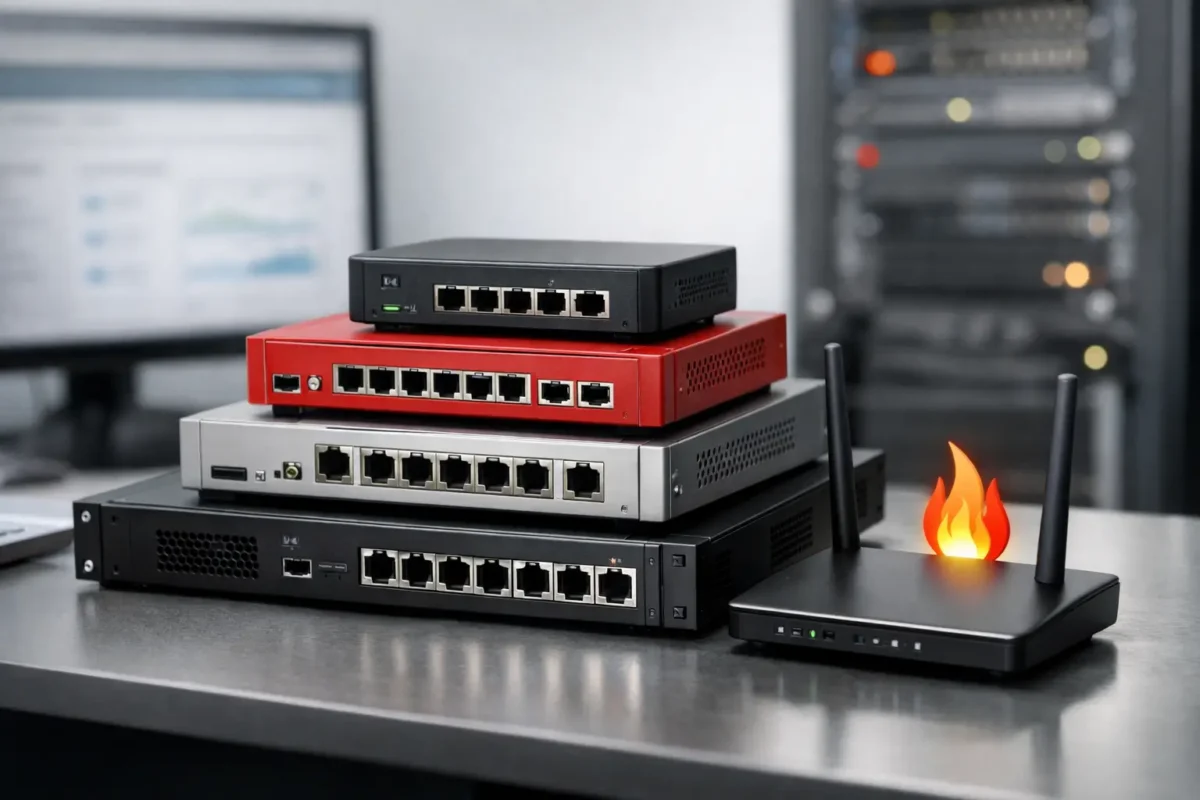
A cheap firewall that drops packets is not a bargain. For most SMEs, the best small business firewalls are the ones that match your user count, WAN mix, VPN load and subscription budget without forcing an early replacement. Buy too little and performance collapses once security services are enabled. Buy too much and you tie up budget in throughput you never use.
That is the real buying problem. Small business firewall selection is rarely about one headline spec. It is about balancing inspection performance, remote access, branch connectivity, licensing, support life, and whether you need a fresh appliance, a certified used unit, or a stopgap replacement to keep an existing estate online.
What makes the best small business firewalls worth buying
For a small office, retail site, clinic, warehouse or multi-branch business, the firewall is not just a box between the internet and the LAN. It is often the edge router, VPN concentrator, web filter and segmentation point for phones, tills, cameras, guest Wi-Fi and cloud traffic. That means raw firewall throughput tells only part of the story.
The spec that matters more in day-to-day use is threat inspection throughput with the security stack turned on. Deep packet inspection, IPS, anti-malware and application control all reduce real-world performance. A unit that looks generous on paper can feel underpowered once users are on Teams calls, cloud backups are running, and site-to-site VPNs are active.
You also need to look at port density and interface speed. Many small firms still run 1GbE at the edge, but that is changing. If you have fibre broadband above 1 Gbps, heavy east-west traffic, or a modern switching estate, 2.5GbE, 5GbE or 10GbE uplinks stop the firewall becoming the choke point. The same goes for PoE environments where VLAN separation is doing serious work across voice, access points and surveillance.
Best small business firewalls by use case
There is no single winner for every estate. The right choice depends on whether you value low-touch management, tight security features, broad compatibility, or low acquisition cost on branded hardware.
Fortinet FortiGate for feature depth and value
FortiGate appliances remain one of the strongest options for smaller businesses that want enterprise-grade security features without stepping straight into enterprise pricing. Businesses looking for a compact and cost-effective option often consider the FortiGate 40F Firewall for branch offices and smaller deployments. They are widely deployed, familiar to MSPs, and strong on SD-WAN, IPS, web filtering and VPN performance. For buyers who need a serious UTM platform in a branch, main office or distributed environment, FortiGate usually sits near the top of the shortlist.
The trade-off is licensing. The hardware can be competitively priced, but the security subscriptions are where the total cost builds. That is not unusual in this market, yet it matters if you are equipping multiple sites. If your team already knows FortiOS, the operational value is strong. If not, there is still a learning curve, although it is manageable for experienced network admins.
Cisco Firepower and Meraki for Cisco-led estates
If the rest of your network is already Cisco, choosing a Cisco firewall can reduce friction. Meraki suits smaller firms that want cloud-based management, simplified policy control and lower-touch administration across branch sites. It is especially appealing when your internal team is small and standardisation matters more than deep local CLI tuning.
Cisco Firepower appliances make more sense where you need tighter integration into broader Cisco security tooling or where procurement requires a recognised OEM with long-term support. The catch is cost. Cisco can be excellent operationally in the right estate, but smaller buyers need to watch the software and licensing model carefully.
Juniper SRX for networking-first teams
Juniper SRX appliances are often a good fit when routing, segmentation and policy control need to sit alongside strong security in a single platform. Teams that already work comfortably with Junos can get a lot from SRX, particularly in environments where branch routing is as important as perimeter security.
For very small businesses without in-house technical capability, SRX may be more appliance than they need. For MSPs and network-led buyers, though, it can be a smart purchase, especially where compatibility with an existing Juniper estate carries real value.
Sophos Firewall for simplified management
Sophos remains popular with smaller firms that want a straightforward interface and a clear feature set around VPN, web filtering and endpoint integration. It is often attractive to businesses without a dedicated security engineer because it is easier to manage than some heavier enterprise platforms.
The main question is scale and future growth. Sophos can serve many SMEs well, but if you expect significant throughput growth, more branch complexity, or heavier inspection demands, you need to size carefully now rather than replace in 18 months.
SonicWall for branch offices and SMB deployments
SonicWall has long been present in the SMB firewall market, and for many branch and office deployments it still makes practical sense. It covers the usual set of security services, supports VPN use cases well enough for most smaller estates, and can be cost-effective depending on the appliance generation and subscription bundle.
As with any subscription-led platform, hardware price alone is not the full picture. Renewal cost needs checking early, particularly for buyers standardising across several locations.
WatchGuard for manageable all-round security
WatchGuard often suits smaller businesses and MSPs that want good central management with a solid spread of security features. It is not always the first brand buyers ask for, but that can work in your favour if you are comparing on value rather than defaulting to the biggest name.
Its fit is strongest where ease of deployment matters and where your team wants competent security coverage without overcomplicating branch rollout.
How to choose the best small business firewalls for your site
Start with users, not marketing tiers. A firewall for a 15-user office with cloud apps and light VPN access is a different purchase from a 60-user site with voice, CCTV, multiple VLANs and regular file transfer. If you expect growth, buy for the next two to three years, not for the current headcount on a quiet Tuesday.
Then look at internet bandwidth and traffic type. A site on full fibre with symmetrical speeds and always-on cloud usage needs more inspection headroom than a lightly used backup office. If you are comparing models for a UK deployment, our guide on Best Firewall for Small Business UK Buyers provides additional insight into sizing, security features and long-term costs. If you are running site-to-site VPNs, count them properly or if remote staff connect daily, include SSL VPN or IPsec load in the decision. This is where many under-sized deployments fail.
Licensing deserves the same scrutiny as the appliance model number. Some buyers save on initial hardware only to find that threat protection, advanced support or central management pushes the three-year cost higher than a better specified alternative. The cheapest unit in the basket is not always the lowest-cost firewall in service.
Hardware lifecycle matters too. Current generation appliances usually give you better efficiency, support runway and interface options, but there is still a strong case for used and legacy enterprise gear when budgets are tight or when you need an exact branded replacement. If your business is extending the life of an existing Cisco, Fortinet, HPE or Juniper environment, compatible stock can be the fastest route back to service without redesigning the edge.
Buying new vs used firewall appliances
New appliances are the safer choice when you need full manufacturer support, current subscriptions, and a clean deployment path for a fresh project. They are also easier to justify when compliance, warranty term and software eligibility sit high on the procurement checklist.
Used hardware can make excellent commercial sense when you know exactly what you are buying. For lab environments, non-critical branches, replacement stock, or estates that already hold the required licences, used branded firewalls can cut costs sharply. The caution is obvious: check support status, firmware eligibility, subscription transfer rules and interface compatibility before you commit.
For many buyers, the sweet spot is not ideological. It depends on the site. A main office may justify a current-generation appliance with a full support bundle, while a warehouse or low-demand branch may be perfectly well served by discounted enterprise hardware with the right specifications.
Common mistakes that cost more later
The first is buying to idle throughput and ignoring inspection performance. The second is underestimating VPN demand. The third is treating licensing as an afterthought. Another frequent issue is choosing a model with too few high-speed interfaces, then adding complexity elsewhere to work around the limitation.
There is also a tendency to buy by brand reputation alone. Brand matters, especially for support and ecosystem fit, but the best firewall for your site is the one that fits your topology, security policy and renewal budget. A smaller FortiGate may outperform a larger-looking alternative if the licence bundle is right. A Cisco option may be the better operational choice if the rest of the network is Cisco-managed. It depends on the estate, not forum noise.
Where the smart buy usually sits
For most SMEs, the strongest buys sit in the mid-range of recognised enterprise brands rather than the absolute entry level. Growing businesses that need more performance headroom frequently evaluate the FortiGate 100F Firewall for larger offices and multi-site environments. That is where you get enough headroom for IPS, content filtering, VPNs and VLAN-heavy traffic without paying for branch features you will never touch. Buyers comparing Fortinet, Cisco, Juniper, SonicWall and similar vendors should focus less on brochure speed and more on supported use case, renewal cost and hardware fit.
If you are sourcing branded infrastructure at discount, that is where stock depth matters. Access to current and used enterprise hardware gives buyers more room to match the firewall to the site instead of forcing the site to fit what is available. For procurement teams and MSPs buying at pace, that flexibility can be just as valuable as a better list price.
A good firewall purchase should feel boring after deployment. No surprise bottlenecks, no awkward licensing shock, no rushed upgrade six months later. Aim for that, and the right model usually becomes clear.
FAQ
Q1: What is the best firewall for a small business?
A: The best firewall depends on user count, internet speed, VPN usage and security requirements. Fortinet, Cisco, Sophos, Juniper and SonicWall are among the most common choices.
Q2: Should small businesses use firewall security subscriptions?
A: Security subscriptions provide features such as IPS, malware protection, web filtering and application control, making them valuable for most business environments.
Q3: Is a used firewall worth buying?
A: Used or refurbished firewalls can offer excellent value for branch offices, backup units and replacement projects when compatibility and support status are verified.
Q4: How do I choose the correct firewall size?
A: Review internet bandwidth, VPN demand, user count and inspection requirements. Buying with some performance headroom can help avoid an early upgrade.
Q5: What is the most common firewall buying mistake?
A: Many buyers focus only on purchase price and overlook inspection performance, licensing costs and future growth requirements.
